Aruba Wildlife: Bats, Iguanas, Lizards, and No Crocodiles
Aruba Wildlife: Bats, Iguanas, Lizards, and No Crocodiles
Aruba has no crocodiles in the wild. No alligators either, unless you count something behind glass at an older island attraction. The creatures you genuinely cross paths with inside Arikok National Park are bats, green iguanas, whiptail lizards, geckos, feral goats, a few donkeys, and an endangered rattlesnake so retiring that rangers go whole seasons without a sighting. None of them hunts people. None of them wants your sandwich.
I have walked these trails since 2016, first as a visitor with a cracked camera screen and later as someone who stayed. Most of the fear I meet near the cave entrance is inherited: picked up from films, from vague resort warnings, from a photo someone’s cousin posted of a caiman in a Venezuelan river. This page unpacks the whole pile, then hands you the practical version. The formal etiquette lives on the Visitor Rules page, and the broader park context sits on the Arikok hub.
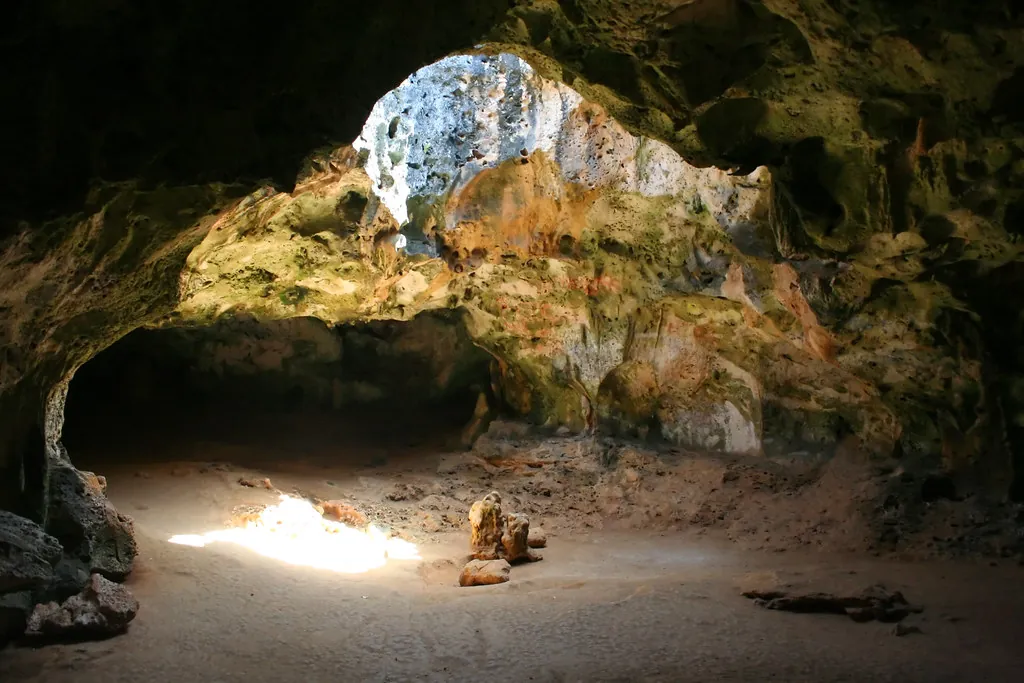
Nothing in Arikok is hunting you. The bats are asleep, the iguanas are sunbathing, and the rattlesnake would rather be anywhere else on the island.
Short version before the detail: bats in Aruba caves are harmless if you keep your voice down and your flash switched off. Iguanas need two metres of space and zero snacks. Lizards and geckos are scenery with legs. Snakes are rare, legally protected, and best left exactly where they are. Crocodiles and alligators are absent from the wild entirely, and a Quadirikiri cave facts list that mentions otherwise was written by someone who has never stood in that chamber.
Wildlife Safety Quick Reference
| Species | Where you meet them | Risk | What to do |
|---|---|---|---|
| Bats (raton di anochi) | Guadirikiri, Fontein and Quadirikiri chambers | Minimal; the rabies worry is largely myth | No flash, low voices, never touch a grounded bat |
| Green iguana | Desert scrub, Arikok trails, resort lawns | Low; tail whip or bite if handled | Two metres back, never feed |
| Whiptail lizards and geckos | Trails, rock walls, hotel balconies | None | Watch, do not catch |
| Aruba island rattlesnake | Arikok interior; very rare | Serious if provoked | Stop, back away slowly, tell a ranger |
| Crocodiles and alligators | Not present in the wild | None | No precautions needed |
Island emergency number: 911. Nearest full hospital: Dr. Horacio E. Oduber in Oranjestad. Park-specific contacts change with staffing, so the Arikok National Park foundation is the source to check before you publish a number anywhere.
Where the Crocodile Fear Comes From
Four separate things feed the worry, and each one is worth pulling apart. The first is a mental map most of us carry from childhood: tropical island equals jungle equals reptiles with teeth. The second is geography. The American crocodile is real and thriving in parts of the Caribbean, in Cuba, Hispaniola and Jamaica, and along the Venezuelan coast, and Aruba sits roughly thirty kilometres off that coast. The third is captivity. Older island attractions kept animals in enclosures, and a photo from one of those tanks resurfaces every few years with a caption that simply says Aruba. The fourth is habitat. The brackish mangrove stands at Mangel Halto, Spanish Lagoon and Pos Chiquito look exactly like crocodile country: tangled roots, warm shallow water, herons standing about with intent.
Looking like crocodile country and being crocodile country are different claims. Aruban mangroves hold fish, crabs, herons and the occasional green turtle. They hold no crocodilians at all. Any crocodile photograph geotagged to this island is captive, mislabelled, or a spectacled caiman shot on the mainland and posted by someone with a loose relationship to geography.
Bats Are Aruba’s Only Native Land Mammals
Take away the feral donkeys and goats, which arrived with people, and the island’s native land mammal list is essentially bats. That single fact reframes the whole visit. The flying creatures overhead at Guadirikiri are not an add-on to the cave experience; they are the reason the cave has an ecosystem in the first place.
Three species are the ones you are most likely to be near. The long-tongued bat (Glossophaga longirostris) works nectar and insects. The Curaçaoan long-nosed bat (Leptonycteris curasoae) is a nectar specialist tied to columnar cacti and agave, which means it pollinates the plants that define the island’s silhouette far beyond the cave walls. The southern funnel-eared bat (Natalus tumidirostris) prefers warm, humid pockets and hangs alone rather than in tight clusters. In Papiamento, bats are raton di anochi, night rats, which is a more honest name than anything English managed. Species lists shift as surveys continue, and the park foundation publishes updates when they land.
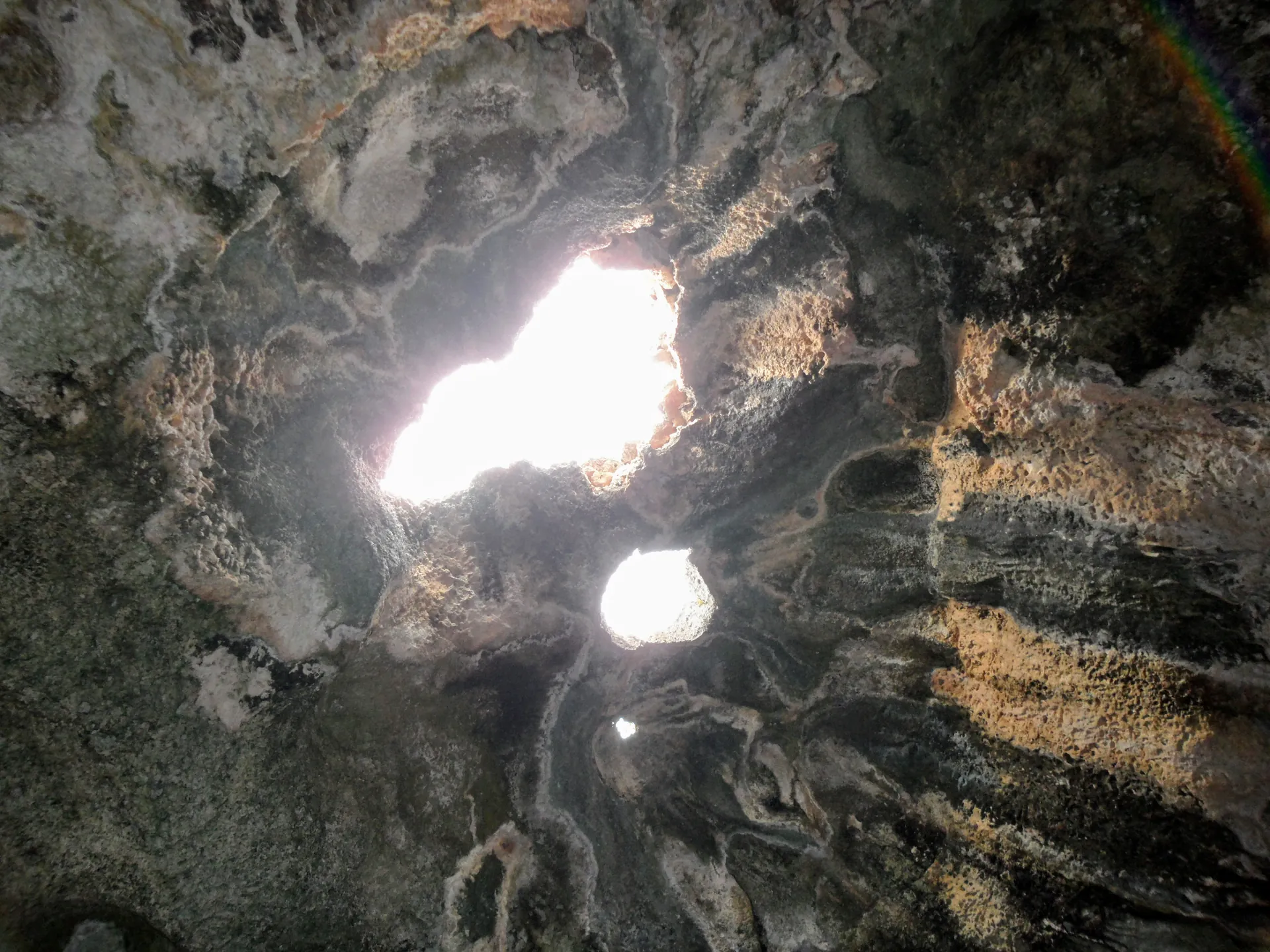
Inside Guadirikiri’s Second Chamber
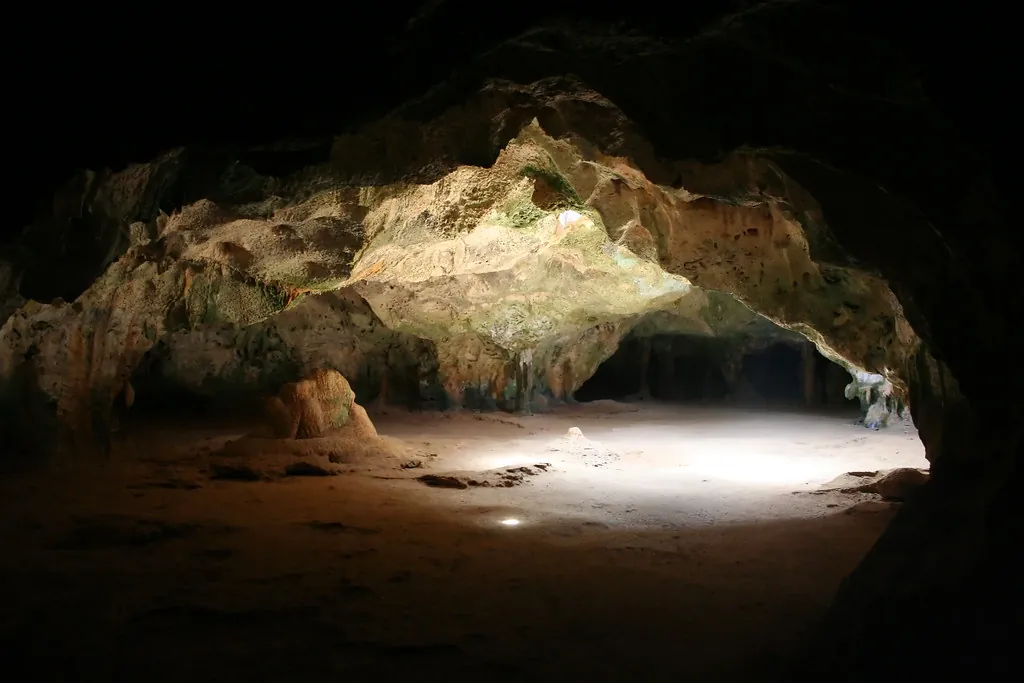
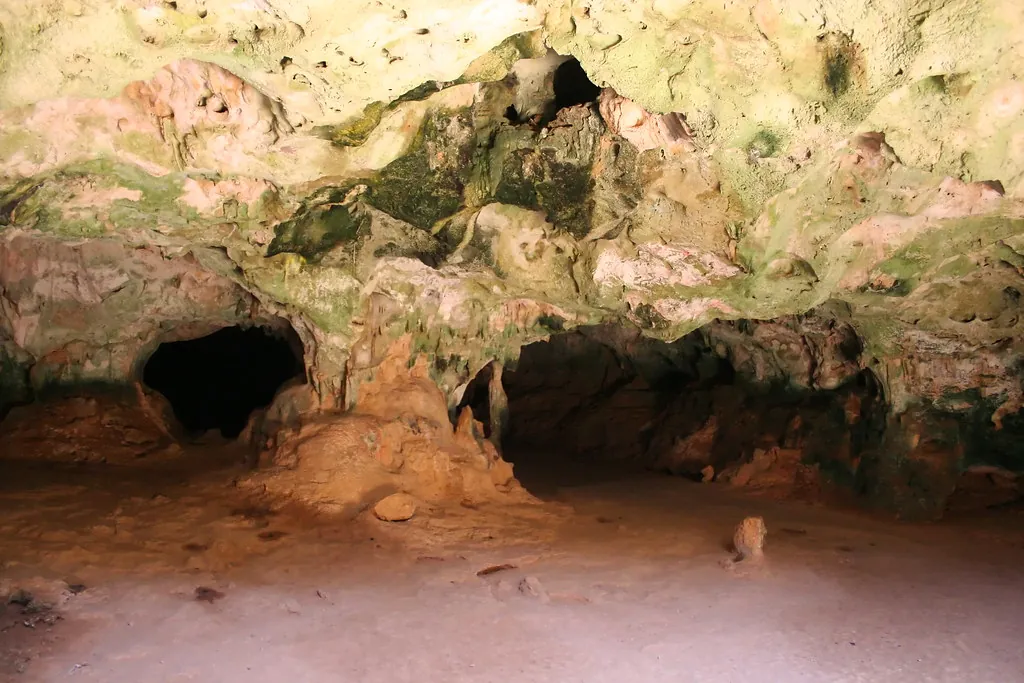
The colony keeps to the deeper, darker chamber, away from the collapsed roof openings that throw those famous light beams across the floor. Chamber one is where cameras go. Chamber two is where the bats are, and the two experiences are not interchangeable. Walk in and your eyes need a full minute before anything registers. Then the rustle registers. Then the smell does.
The smell is ammonia, released as guano breaks down on the cave floor. Guano is the foundation everything else in the cave builds on: it feeds insects, insects feed the colony, and the whole loop runs in the dark without any help from visitors. Bats leave around dusk to feed, which is why late afternoon visits catch more movement than midday ones. The Best Time page maps light, heat and colony behaviour together, and the History and Geology page follows the guano thread through the cave’s formation.
Local tip: give the second chamber a full minute of silence before you lift a camera. Your eyes adjust, the colony settles, and the room starts to sound like a room. Rangers will tell you the same thing, usually with a grin.
Bat Etiquette: Flash, Torch Discipline and Volume
Every rule here has a consequence behind it, and the consequences are physical rather than moral. A flash burst wakes roosting bats and burns energy they cannot easily replace. A sweeping torch beam does the same, only slower. Noise pushes the colony deeper, which ruins the visit for everyone behind you and stresses animals that already live on a tight margin.
- No flash photography at any distance, including phone flashes set to auto.
- Aim your beam at the floor, or at the walls around waist height.
- Keep conversation low and short. Whispering is fine. Filming a monologue is not.
- Never touch a bat on the ground. Call a ranger instead.
- Leave the ceiling and roost surfaces alone, hands and selfie sticks included.
Do
- Stay on marked paths.
- Bring a zoom lens or use phone night mode.
- Carry water, always.
- Speak softly and stand still.
Don’t
- Feed any animal, anywhere.
- Use flash on roosting bats.
- Touch formations or roost surfaces.
- Corner an iguana for a photograph.
Iguanas, Lizards and the Ground Crew
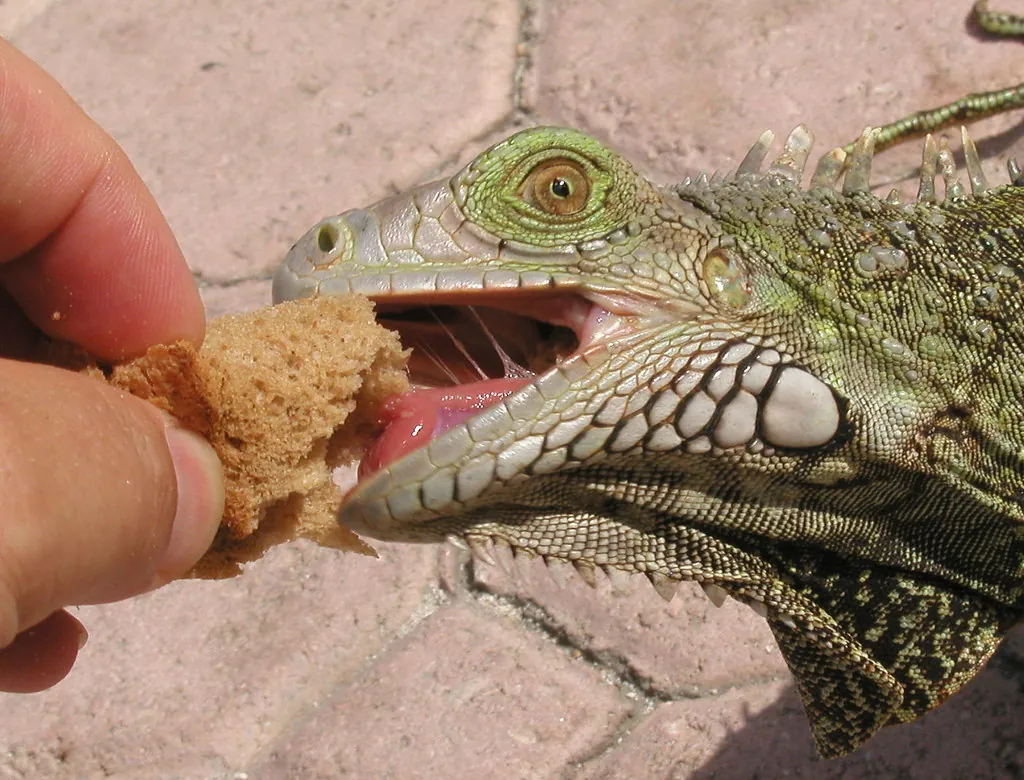
Green iguanas are the island’s most photographed reptile, and they know it. They bask on limestone ledges, drop from branches when startled, and whip their tails when cornered. That tail is a proper weapon and it can split skin, so two metres of space is not politeness, it is common sense. Feeding them changes behaviour and puts the next visitor in the firing line. The Aruba whiptail lizard is endemic, found here and nowhere else on earth, and it sprints across the trail in short bursts that make photography a lottery. Geckos handle the vertical architecture: balconies, bathroom walls, the underside of outdoor lamps.
Snakes, Including the One You Won’t See
Aruba has a very short snake list. The headliner is the Aruba island rattlesnake (Crotalus unicolor), endemic to this island, critically endangered, and estimated in the low hundreds. It lives in the arid interior where the limestone cracks give it cover, and it is protected under Aruban law. Records also include the Aruba cat-eyed snake, a slender non-venomous night hunter that eats frogs and lizards and poses no threat to anyone walking a trail in daylight.
If you meet a snake, stop walking, note the spot, and step back along the path you came from. Do not throw anything, do not try to move it, do not kill it. Report the sighting to a ranger, who will log it and be quietly delighted, because sightings are data and data is how the population gets monitored. Bites on visitors are vanishingly rare, and no documented incident has occured inside the cave itself.
Aruba has one venomous snake, an endangered endemic that hides in the desert, and you almost certainly will not meet it.
Rabies in Aruba: Reading the Record Properly
Aruba sits among the Caribbean islands with no recent record of terrestrial rabies in dogs or cats, and no documented human cases in the modern public health record. Bat rabies exists as a theoretical concern almost everywhere bats exist, which is why the practical rule matters more than the statistics: never pick up a bat with bare hands, and never handle one that has fallen. If a bat is grounded inside a chamber, mark the location in your memory, tell a ranger, and let trained hands deal with it. If someone is bitten or scratched, wash the wound with soap and running water for fifteen minutes and get to the Dr. Horacio E. Oduber Hospital in Oranjestad the same day. Current public health advisories sit with the Government of Aruba, and the CDC rabies pages explain the treatment protocol in plain language.
Why There Are No Crocodiles Here
The short answer is water, or the lack of it. Aruba gets roughly half a metre of rain a year, sits in steady trade winds, and drains almost instantly through a limestone and coral base. There are no rivers, no lakes, no waterfalls and no jungle, which is exactly why the island looks the way it does. Crocodilians need permanent fresh or brackish water with reliable prey, and the island’s few seasonal ponds dry out before a breeding population could establish. Visitors asking about jungles or waterfalls are describing a different Caribbean entirely, and the answer to both is the same: not here, and the desert animals are better for it.
Swimming works the same way. There are no natural freshwater swimming holes in Arikok, and the cave pool at Guadirikiri is closed to entry, with the natural pool on the coast dependent on sea conditions and occasional closures for safety. The Rules page covers what that means in practice. Nobody is keeping a nice swimming spot from you; the water simply is not there.
Distance, Water and Desert Heat
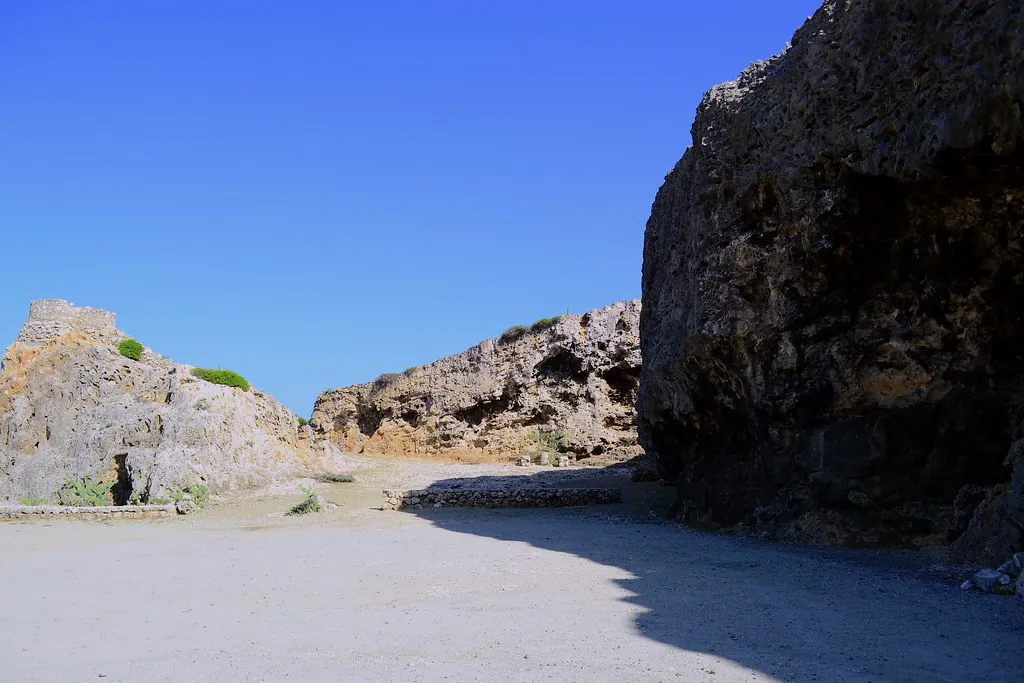
Wildlife is the small risk in Arikok. Heat is the large one. Two litres of water per person for a half-day, closed shoes for the limestone, a hat that stays on in wind, and a phone battery you have not drained on photos before the walk back. Signal drops in the park’s interior, which is another reason to tell someone your route. The packing and desert safety guide goes deeper on all of it, and the cave etiquette post covers behaviour across the island’s caves.
Guided Tours and Ranger Context
Ranger programmes inside the park interpret the wildlife properly, and a guide will usually spot more in four hours than most visitors manage in a day. Vehicle-based options work well if you want the park, the coast and the caves in one push. The National Park Arikok Jeep Safari runs four hours through the northern side at around $109, and the Natural Pool, Caves and Baby Beach jeep day strings Guadirikiri together with the coast for roughly $89. Choosing between the two famous caves on the same loop is its own decision, covered in the Fontein versus Guadirikiri comparison. Bookable options and current rates sit on the Tickets page, access logistics on the Transport page.
Conditions Before You Drive Out
Afternoon heat inside the park runs several degrees above the resort strip, and the cave chambers stay warm and humid regardless of the forecast. If the wind is up, the dust on the approach roads gets interesting. Check conditions before you leave Oranjestad or Noord, and plan the cave for the morning if you want the light beams.
Official Sources and Park Rules
- Arikok National Park foundation: entry fees, opening hours, ranger programmes and closures.
- Aruba Tourism Authority: island-wide visitor information and seasonal events.
- Government of Aruba: public health notices, protected species law and park regulation.
- Dutch Caribbean Nature Alliance: conservation work and species monitoring across the ABC islands.
- CDC rabies guidance: what to do after any animal bite or scratch.
That is the whole picture. A desert island with a short animal list, one endangered rattlesnake worth protecting, and a cave colony that asks only for quiet and darkness. Walk in slowly, keep your hands to yourself, and the wildlife will repay you with the strangest, calmest hour of your holiday.
For the full visitor framework, read the Rules and Guidelines page next, then the Arikok National Park hub if you are planning the drive.