Beyond Guadirikiri Cave: Arikok National Park & Nearby Caves
Guadirikiri Cave makes sense once you stop treating it as a solitary attraction and place it inside Arikok National Park. The park covers nearly a fifth of Aruba, with limestone terraces, volcanic hills, divi-divi scrub and a wind-battered coast spread across roughly 34 km². This is the Aruba that exists beyond the resort strip: drier, rougher and much more geological, with old plantation traces and caves tucked into the inland landscape. The official Aruba tourism authority describes Arikok as a protected area with caves, beaches, rock formations and marked trails, and its visitor centre is the sensible place to begin if you want the wider picture rather than a single photo stop. Arikok National Park visitor information.
The park is the island’s memory; the resort strip is the island’s shopfront.
That distinction matters when deciding whether Arikok deserves half a day or most of one. You can dip into the park for Guadirikiri and Fontein, or you can build a slower loop around caves, coastal viewpoints, the Natural Pool and a walking trail. Bring water either way. The sun has very little sympathy for optimistic holiday footwear.
For current conditions, access arrangements and conservation information, check the Government of Aruba information on Fundacion Parke Nacional Arikok before setting off. Park management and infrastructure can change, and the government has documented ongoing work around sites including Conchi, Fontein and Quadirikiri. Government information on park infrastructure and conservation.
The park at a glance
| Practical Point | What to Know |
|---|---|
| Typical public opening hours | 8:00 am–4:00 pm; confirm current access before travel |
| Main visitor centre | San Fuego, Santa Cruz |
| Park entry | Conservation day pass required; check current tariff with park office |
| Caves | Guadirikiri and Fontein are within Arikok National Park |
| Road conditions | Some park roads are rough or unpaved; access restrictions can change |
| Best preparation | Water, sun protection, closed-toe shoes and charged phone / offline map |
The public-facing Aruba tourism information currently lists the caves as accessible during the national park’s daytime opening period, 8:00 am to 4:00 pm, and confirms that a park ticket is required. The same source recommends speaking with park rangers at the cave entrances, which is particularly useful at Fontein, where the cultural history matters as much as the limestone. Official Aruba caves information. I would not print a fixed ticket price into a long-lived guide without checking the current tariff: Aruba’s government has amended the statutory access-fee regulations in recent years. Government regulation on Arikok access fees and Government gazettes concerning later fee changes.
One practical wrinkle deserves more attention than it usually gets: a national-park ticket does not magically turn every road into a rental-car road. Check your rental agreement before taking an unpaved route, particularly if your plan includes Conchi or rougher coastal sections. A normal car can be perfectly sensible on permitted paved or maintained routes, while a 4×4 is recommended for parts of the park and is particularly relevant for the Natural Pool route. The official Aruba tourism authority recommends four-wheel drive for exploring the park by vehicle. Aruba experience map and park orientation.
The cave cluster: Guadirikiri, Fontein and the Indian Cave area
Think of the central Arikok cave area as a cluster rather than a neat little museum complex. Guadirikiri gives you the dramatic roof openings and shafts of daylight; Fontein carries the strongest cultural and archaeological interest; the Huliba or Indian Cave area belongs to the wider story of Aruba’s limestone shelters and Indigenous associations, but access can vary, so don’t assume a named cave on an old map is automatically open to visitors. A proper Quadirikiri cave map is useful for orientation, yet the park’s current road signs and ranger information should take precedence over an old screenshot saved on your phone.
- Guadirikiri: go for the two main chambers, collapsed roof openings, shafts of sunlight and the darker passage where bats roost.
- Fontein: go for the rock art and the chance to connect the cave landscape with Aruba’s Indigenous history.
- Huliba / Indian Cave area: treat it as a location whose current access needs checking rather than as a guaranteed walk-in attraction.
- Natural Pool: make it a separate coastal stop within the park loop, and check the current route and swimming conditions before committing the afternoon to it.
All of this sits inside a protected landscape, so the park pass is the common starting point, while individual access arrangements can still differ. The official tourism authority confirms that Guadirikiri and Fontein are inside Arikok and that visitors need a park ticket. Aruba’s official cave guide.
Guadirikiri Cave in brief
Guadirikiri, also written Quadirikiri, is the cave for people who like their limestone with a shaft of sunlight dropped through the ceiling. The main chambers are connected by darker passages, and the official Aruba tourism material describes a cave roughly 100 feet long with hundreds of harmless bats in its darker portions. The roof openings create the cathedral effect, especially when sunlight lands cleanly on the floor, while the deeper sections turn proper dark surprisingly quickly. Official Quadirikiri Cave information. For the detailed chamber-by-chamber guide, use our Guadirikiri Cave guide, and for composition ideas and low-light settings, see Guadirikiri Cave photos and chambers.
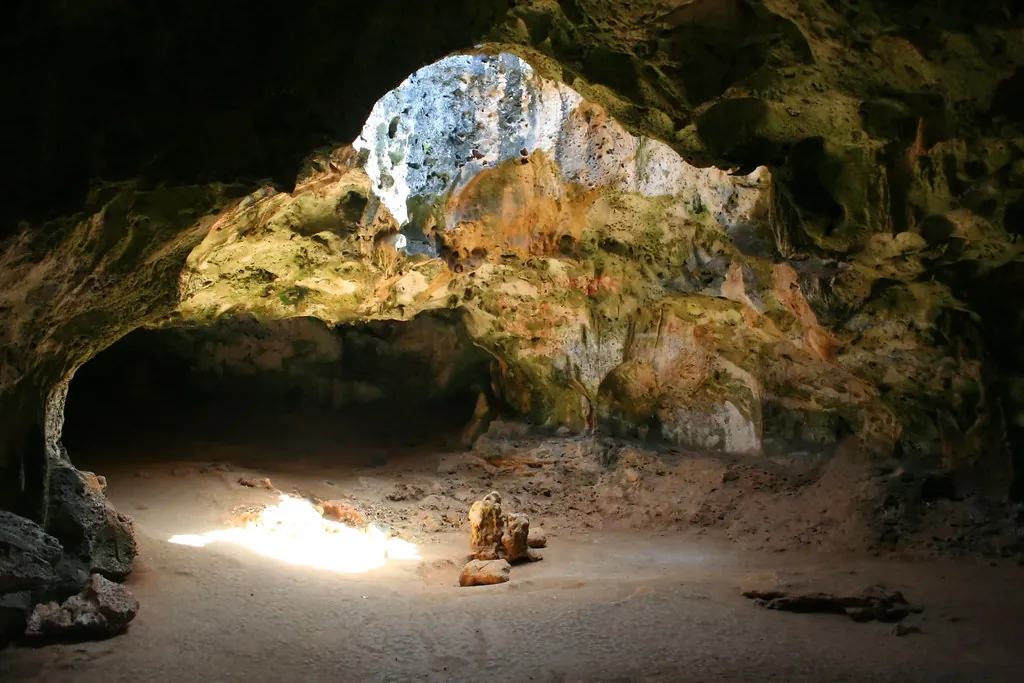
If you bring a camera, expose for the limestone rather than the bright sky above the opening, then lift the shadows gently in post-processing. A phone held steady against a rock can work better than waving its torch around while everyone waits. Keep lights and flash away from bats, give them room, and let the cave remain a cave.
Fontein Cave: the one with the drawings
Fontein has a different rhythm. Its importance comes from the rock art associated with Aruba’s Indigenous inhabitants, with drawings and etchings covering sections of the walls and ceiling. The official tourism authority identifies Fontein as the cave known for Arawak-associated drawings, while also describing its limestone formations and humid interior. Official Fontein Cave information.
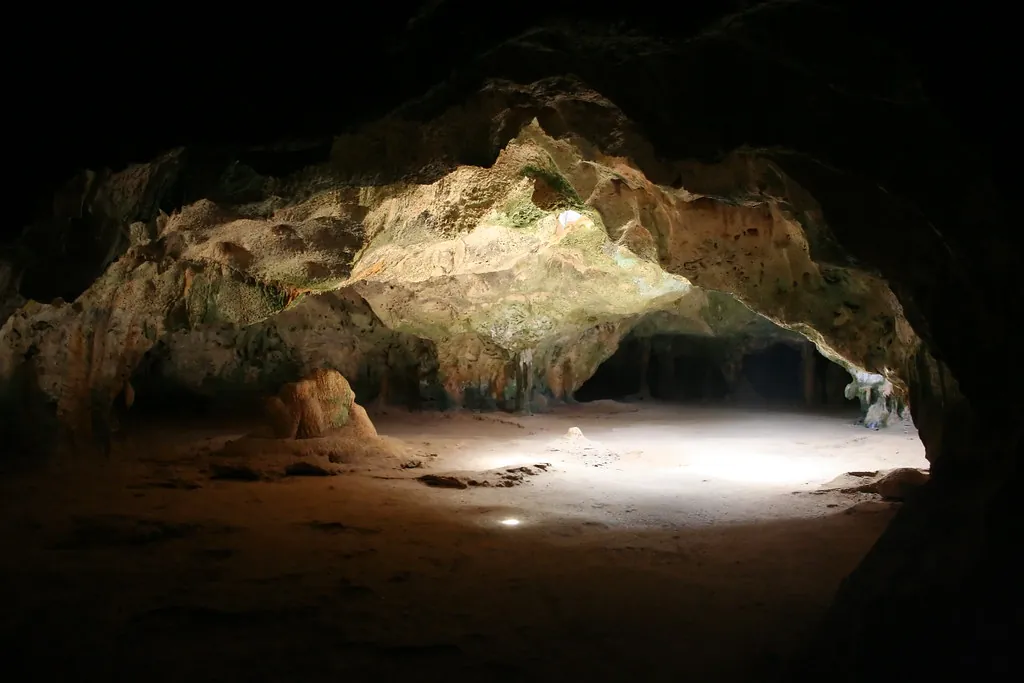
This is where a ranger can change the experience. Rock drawings are easy to flatten into a single sentence about “ancient Indians” and move on, but the cultural record deserves more care than that. Listen to the interpretation available on the day, follow any controlled-access instructions, and keep your hands off the surfaces. The cave is part of a protected cultural landscape, not a prop for holiday selfies.
Fontein vs Guadirikiri: pick by experience
Choose Guadirikiri when the light matters. Its roof openings create the strongest visual drama, and the contrast between bright shafts and the darker tunnel gives photographers something to work with even on a short visit. The walking experience is more about chambers, openings and cave atmosphere.
Choose Fontein when cultural history matters most. The rock drawings are the reason to slow down, listen and look carefully. Access and ranger involvement can be more significant here, so leave room in your schedule rather than treating it as a five-minute roadside tick.
| Factor | Guadirikiri Cave | Fontein Cave |
|---|---|---|
| Photography | Strong natural shafts of daylight and deep cavern shadows | Detail-focused, especially around historic rock drawings |
| Cultural Interest | Folk legends and bat habitat | Arawak/Caquetío rock drawings with archaeological focus |
| Lighting Conditions | Bright roof openings against dark chambers | Generally darker interior conditions throughout |
| Ranger Involvement | Informative entrance staff; self-guided walk | Particularly useful for interpreting rock art on walls |
| Walking Route | Chambers and darker passage; uneven limestone | Short cave approach with uneven natural limestone |
| Time Needed | 30–45 minutes; easy to fit into park loop | 30–45 minutes; allow extra time for ranger explanation |
The dedicated Fontein vs Guadirikiri comparison goes deeper into accessibility, photography, timing and tour combinations. There is no universal “better” cave here; they answer different travel interests, which is rather more useful than a star rating invented for the sake of a table.
Natural Pool, Indian caves and the wider loop
Arikok makes more sense as a sequence of possible stops than as a rigid checklist. Conditions, road access and your own tolerance for Aruba’s heat can change the shape of the day. A sensible loop can begin at San Fuego, continue towards Fontein and Guadirikiri, then head towards an open Huliba or Indian Cave area, before reaching the Natural Pool section if the current road and conditions permit.
- San Fuego visitor centre: collect current park information, check conditions and get your bearings before heading deeper inland.
- Fontein Cave: spend time with the rock art and ranger interpretation.
- Guadirikiri Cave: allow time for both the sunlit chamber and darker passage.
- Huliba / Indian Cave area: visit only where current access permits.
- Natural Pool, or Conchi: treat the route as a 4×4-oriented section and check current conditions before driving there.
- Coastal stops: Boca Prins, Dos Playa and Daimari add sea views and a different side of the park’s geology.
Arikok is thirsty country. I carry more water than I think I need, because the one thing I never regret hauling around Aruba is an extra bottle.
And one persistent internet muddle deserves clearing up: Guadirikiri is not a swimming cave. Aruba has natural pools, including Conchi, but that does not turn every dark hole in Arikok into a cave-pool attraction. Current conditions, surf and park restrictions can affect access and swimming, so check before making the pool the fixed centrepiece of your day. The official tourism authority lists Natural Pool as one of Arikok’s major natural attractions. Aruba natural wonders information.
Getting around Arikok
Self-drive
- Check the rental agreement before using unpaved park roads.
- Stay on routes permitted for your vehicle.
- Expect slower progress on rough surfaces.
- Carry water and an offline map.
Guided or private transport
- Useful when you do not want to drive rough roads.
- Jeep excursions can combine caves, Natural Pool and coastal stops.
- Ranger programmes add park interpretation rather than simply transport.
- Check exactly which sites and transfers are included before booking.
Before you hand over the rental keys, read the section about unpaved roads. “It is inside a national park” is not the same thing as “my rental insurance covers it.”
Our Guadirikiri transport guide covers the practical route in more detail, including rental cars, taxis and transfers. If you prefer a bundled excursion, compare current tickets and tour options rather than assuming every Quadirikiri cave Aruba tour visits the same places.
Ranger tours and guided visits
Guided visits make most sense when the story behind the landscape matters to you. A ranger can point out plants, geology, cultural sites and wildlife that are easy to drive past, while a commercial Jeep or 4×4 excursion often combines several attractions into a single half-day or full-day route. These are different products, so check whether the person leading the trip is a park ranger, a licensed commercial guide, or a driver-guide working for a tour company.
- Check the current ranger programme rather than assuming a tour runs every day.
- Ask whether park admission is included in a commercial tour price.
- Confirm whether Guadirikiri, Fontein and Natural Pool are all on the itinerary.
- Ask about vehicle type if the route includes rough park roads.
- For cultural sites, give the guide time to explain the place rather than rushing from photograph to photograph.
Commercial excursions can be useful for visitors without a suitable vehicle, particularly when the itinerary bundles transport with several inland stops. For current booking choices, see our Arikok and cave tours page.
The Arikok day: half-day or full loop
A half-day works if Guadirikiri and Fontein are the main event. Start early enough to beat the strongest heat, enter through the appropriate gate, spend proper time at the caves, then choose one additional park stop before heading back towards the coast. This leaves breathing room for parking, slow roads and the inevitable “just five more minutes” with the camera.
A full day changes the pace. You can begin at San Fuego, spend the morning around the caves, continue towards Cunucu Arikok or a walking trail, then work towards Boca Prins, Dos Playa or Daimari before considering the Natural Pool route if it is open and suitable for your vehicle. The official Aruba experience map lists these attractions as part of the wider park landscape. Official Aruba experience map.
- Morning: visitor centre, Fontein and Guadirikiri.
- Late morning: a short walk or cultural stop, with water and shade breaks.
- Midday: slower coastal driving and lunch outside the most exposed walking periods.
- Afternoon: Natural Pool or another coastal stop if current access allows.
- Before4 pm: work back towards the appropriate exit rather than cutting the park’s closing time fine.
Wildlife in the park, including the bats
Arikok’s wildlife fits its dry landscape. You may see the shoco, Aruba’s burrowing owl, the prikichi or Aruban parakeet, trupial birds and whiptail lizards. Goats and donkeys are also part of the landscape, although neither should be treated as tame roadside pets. The Cascabel, Aruba’s rattlesnake, is much less likely to become part of a normal sightseeing day, but it is one reason sensible footwear and distance from wildlife matter.
Inside Guadirikiri, the bats are doing a job rather than performing a horror-movie role. The darker cave sections give them shelter, and the official Aruba tourism authority describes them as harmless. Official Aruba cave information. Keep voices low, do not chase animals for photographs, and avoid shining bright lights directly at roosting bats. A cave is their habitat before it is our backdrop.
Beyond the caves
Donkey Sanctuary Aruba: Pair it with an Arikok day if you want another perspective on Aruba’s relationship with introduced and working animals. Give yourself separate time rather than trying to squeeze it between two cave visits.
San Nicolas street artWorks well with a southern Aruba route after exiting the park, particularly if your day finishes near Baby Beach.
Butterfly Farm: Pair it on a different day or with a lighter itinerary. After a hot walk through limestone country, a calmer attraction can be a welcome change of gear.
Antilla Shipwreck: This belongs to Aruba’s marine side rather than the Arikok cave circuit, so treat it as a separate north-coast excursion rather than pretending the geography is tighter than it is.
There are also more adventurous caving possibilities around Aruba, but old references to “Indian caves” and alternative cave names can be confusing. Current access matters more than an old travel blog, particularly in a protected area where conservation work and visitor controls can change.
Heat, roads and the mistakes worth avoiding
- Take more water than your beach bag suggests.
- Arikok’s trails can have very little shade, and the combination of heat, wind and exertion can catch visitors out.
- Wear closed-toe shoes.
- Limestone is unforgiving to flip-flops, particularly around cave approaches and rough paths.
- Charge your phone before entering.
- Do not build the day around a live signal that may disappear on remote roads.
- Do not touch cave formations or rock art.
- Skin oils and careless contact can damage surfaces that have survived for far longer than any visitor.
- Do not enter a cave pool because a photograph online makes it look inviting.
- Current closures and safety restrictions take precedence over old social-media posts.
- Watch your footing around the Natural Pool.
- Sea conditions and wet rocks can make the coast hazardous even when the sky looks perfectly friendly.
Our Arikok packing and desert-safety guide goes into water, footwear, sun protection, vehicle limits and heat in more detail, while Arikok visitor rules covers cave etiquette, wildlife and closures. The park rewards patience; it punishes the assumption that a Caribbean island must have easy terrain everywhere.
Is Arikok worth the time?
Arikok is worth considering when you want to see the geological and cultural side of Aruba rather than spending the whole holiday beside the resort coast. The strongest case is practical: the park puts caves, dry-land geology, Indigenous cultural history, rough coastline and walking routes within the same broad destination, and the official tourism authority describes nearly 20% of Aruba as designated national park. Official Arikok National Park information.
Arikok fits well if you:
- Enjoy caves, geology or natural history.
- Want Aruba beyond the hotel zone.
- Are comfortable with slower driving and rougher terrain.
- Have several hours for inland and coastal stops.
- Like combining a little walking with sightseeing.
Plan more carefully if you:
- Have limited mobility around uneven cave and trail surfaces.
- Are relying entirely on taxis.
- Are travelling during extreme heat.
- Need every stop to be accessible by a standard rental car.
- Are building the day around a site that may be temporarily restricted.
For a cave-focused visit, two to four hours can cover the principal stops without turning the day into a race. For the broader park, allow most of a day and accept that rough roads, heat and photo stops will stretch the clock. You can drive yourself where your vehicle and rental agreement permit it; a guided 4×4 excursion makes more sense when the route includes rougher sections or when you want someone else watching the road while you stare at the landscape.
Plan the Arikok day
Use this page as the hub, then move into the practical guides according to the sort of day you are building. For tickets and current tour combinations, see Tickets & Tours. For driving, transfers and vehicle restrictions, use How to Get to Guadirikiri Cave. For cave etiquette and current visitor rules, see Visitor Rules & Guidelines. If you are choosing between the two principal caves, the dedicated Fontein vs Guadirikiri comparison keeps the decision neatly focused.
And when the afternoon light catches the limestone through Guadirikiri’s roof, slow down. That is the bit worth having a chipped enamel mug and a ridiculous amount of camera patience for.
Official park information and useful sources
- Aruba Tourism Authority: Arikok National Park, for the park overview, attractions and current visitor orientation.
- Aruba Tourism Authority: Quadirikiri and Fontein Caves, for cave descriptions, daytime access and park-ticket information.
- Aruba Tourism Authority: Experience Map, for the wider park landscape and attraction locations.
- Government of Aruba: Fundacion Parke Nacional Arikok, for the official park-management body and government contact information.
- Government of Aruba: ATA and FPNA park-management agreement, for documented conservation and infrastructure work at Arikok sites.