Fontein Cave vs Guadirikiri: Which Aruba Cave Should You Visit?
The gate at San Fuego swings open around eight, the air is still cool enough to make you smug about the early start, and the map on the wall hands you two circled names: Fontein and Guadirikiri. They sit roughly three kilometres apart on the same limestone ridge inside Arikok National Park, and one day pass covers both, which shrinks the whole either/or drama before it starts. The real divide is what you want from a hole in the ground. Pigment on stone explained by a ranger with a torch, or a collapsed roof pouring a column of daylight onto a chamber floor the size of a village church.
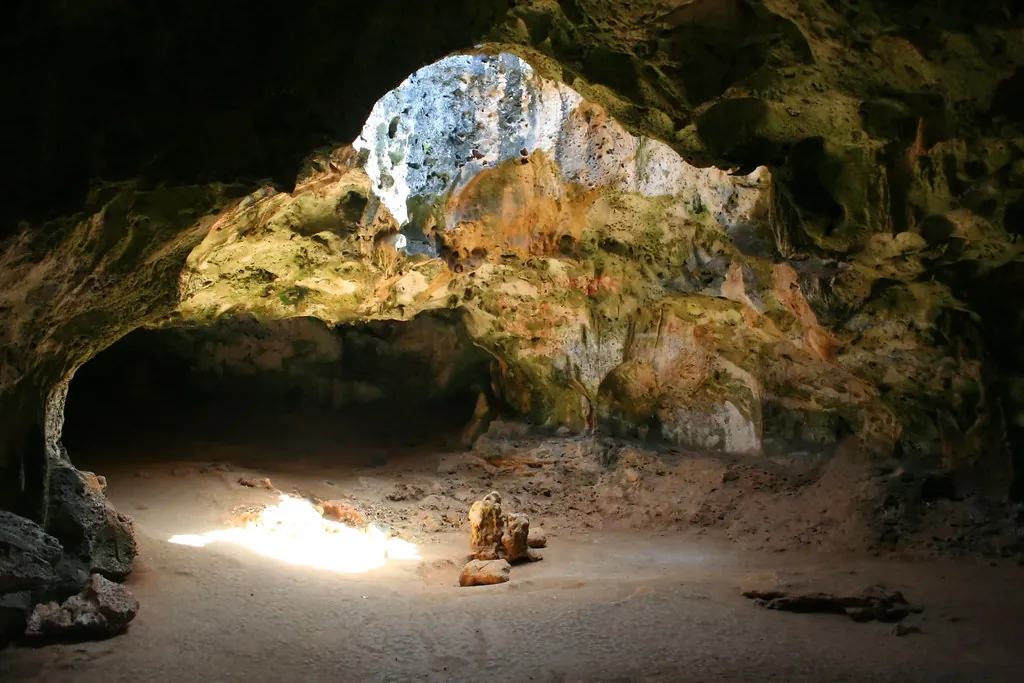
I’ve been bouncing between Bristol and Aruba since 2016, and this is the pairing I get asked about most. I’ve lost count of the mornings I’ve parked at Guadirikiri with a chipped enamel mug of coffee and watched a tour group walk in, take three phone snaps, and leave before the light did its best work. Fontein gets the opposite treatment. People hurry through it because a ranger is standing there in uniform, and the whole thing feels like a queue until you register what you’re actually looking at. Here’s what you’re walking into.
The 30-second verdict
| Cave | Best for | Access | Time on site | Photography |
|---|---|---|---|---|
| Fontein Cave | Arawak and Caquetío rock paintings, cultural history, ranger storytelling | Ranger-supervised, small chamber, guided torch sweep | 15 to 20 minutes | Very low light, no flash on the pigment, steady hands |
| Guadirikiri Cave (also spelled Quadirikiri) | Scale, skylight beams, the bat colony, wandering at your own pace | Self-guided, steps down to the mouth, uneven floor | 30 to 45 minutes | Light shafts, wide angles, tripod territory |
- Choose Fontein when rock art and ranger interpretation matter more to you than elbow room.
- Choose Guadirikiri when you want scale, skylights, and the freedom to stand still for twenty minutes without being moved along.
- Both caves sit inside one Arikok day pass. No separate cave ticket exists, whatever a man in a safari shirt tells you at the gate.
Where each cave sits inside Arikok
Arikok is bigger than most first-timers expect, roughly a fifth of the island, and it has two working entrances. The San Fuego gate on the Santa Cruz side puts you closest to Fontein Cave, Boca Prins, Dos Playa, and the Visitor Center. The Sero Colorado gate on the eastern edge lines you up with Guadirikiri Cave, the Conchi Natural Pool, and the smaller Indian caves tucked into the same ridge. Neither gate is better; they just feed different loops, and rental car rule number one is that the unpaved roads inside the park are not for low-slung saloon cars.
San Fuego side
- Fontein Cave, ranger-led, first stop of the day
- Boca Prins dunes and the snack hut
- Dos Playa, two swimming bays with no shade
- Visitor Center for maps and park rules
Sero Colorado side
- Guadirikiri Cave, walk-in, no ranger required
- Conchi (the Natural Pool), reached by dirt track
- Indian Cave and the northern cliffs
- Ayo and the Casibari boulders further west
Rough driving times once you’re past the gate
- San Fuego gate to Fontein Cave: about 8 minutes
- San Fuego gate to Guadirikiri Cave: about 10 minutes, all paved
- Fontein to Guadirikiri, the short hop: 5 to 7 minutes
- Sero Colorado gate to Guadirikiri: about 6 minutes
- Guadirikiri to Conchi Natural Pool: 15 to 20 minutes on rough dirt
That five-minute drive between the two caves is why I push people to stop treating this as a choice. You can see both inside a single morning without breaking a sweat, and that’s before you’ve counted the coastline stops on either route. The wider park circuit, including playa viewpoints, bat caves, and the odd iguana crossing the road with zero urgency, is laid out on our Arikok National Park hub.
What one park fee actually covers
This is the myth I’d most like to bury. There is no Fontein ticket. There is no Guadirikiri ticket. You pay once at the gate for the Arikok day pass, and both caves fall inside it, along with every beach, trail, and viewpoint in the park. Tours sold online bundle the same park fee into their price, which is why a jeep safari looks expensive until you add up the separate pieces yourself. Current rates live on our tickets and tours page, and the gate takes cash and card.
| What you pay for | Typical cost | Notes |
|---|---|---|
| Arikok day pass, adult non-resident | about $11 (roughly Afl 20) | Confirm at the gate, fees shift with the season |
| Children, roughly 4 to 12 | about $6 (Afl 10) | Under-4s generally walk in free |
| Fontein Cave entry | included in the pass | Ranger supervision comes with it |
| Guadirikiri Cave entry | included in the pass | No gate, no separate payment |
| Guided jeep or UTV safari touching both | $89 to $139 and up | Park fee usually bundled, plus pickup |
Fontein Cave: rock art and a ranger’s torch
Fontein means fountain in Dutch, and the name comes from the freshwater spring that still seeps through the rock at the back of the chamber, a small green promise in the middle of a desert island. The paintings themselves are Caquetío, the Arawak-speaking people who lived here long before the Spanish arrived, and they survive in browns and whites on a ceiling that sits close enough to touch. You do not touch. The chamber is small, maybe the size of a generous living room, and access is ranger-supervised so that a hundred hands a day don’t wipe away a thousand years of pigment.
The ranger’s torch is the best museum light you’ll get in Aruba (and the only one you’re allowed to use on the art). Camera flash is banned, voices stay low, and the sweep across the ceiling lasts about ninety seconds. Watch where the beam pauses, because that’s where the detail is.
What does a ranger stop actually feel like? Shorter than you expect and better than you fear. You get a briefing outside, a slow file in, one torch sweep of the ceiling with a short explanation of who painted what and why, a minute to look, and then you’re out in the sun again squinting at your own photographs. Fifteen minutes, give or take, and the ranger’s knowlege of the site is the part you’ll remember. Ask about the spring before you leave.
- Arrive early. The ranger-led entry runs in small batches and midday brings the jeep convoys.
- Pocket torches are fine outside the painted chamber, useless inside it. Let the ranger lead.
- No tripods in the painted section. Space is tight and you’ll block the lineup.
- Cash is useful for the gate and the Boca Prins snack hut, card works too.
Guadirikiri Cave: two chambers, two skylights
Guadirikiri is the show-off of the pair, and I mean that fondly. The roof has collapsed in two places, so you walk into a long limestone tunnel lit from above by two ragged holes in the ceiling. Chamber one is the wide, brighter room nearest the stairs, the one where tour groups stop and pose. Chamber two is deeper, taller, and darker, with walls honeycombed by water and time, and it’s the room that made me reach for a cathedral comparison the first time I stood in it. The acoustics are church-like too, which is exactly why you should whisper.
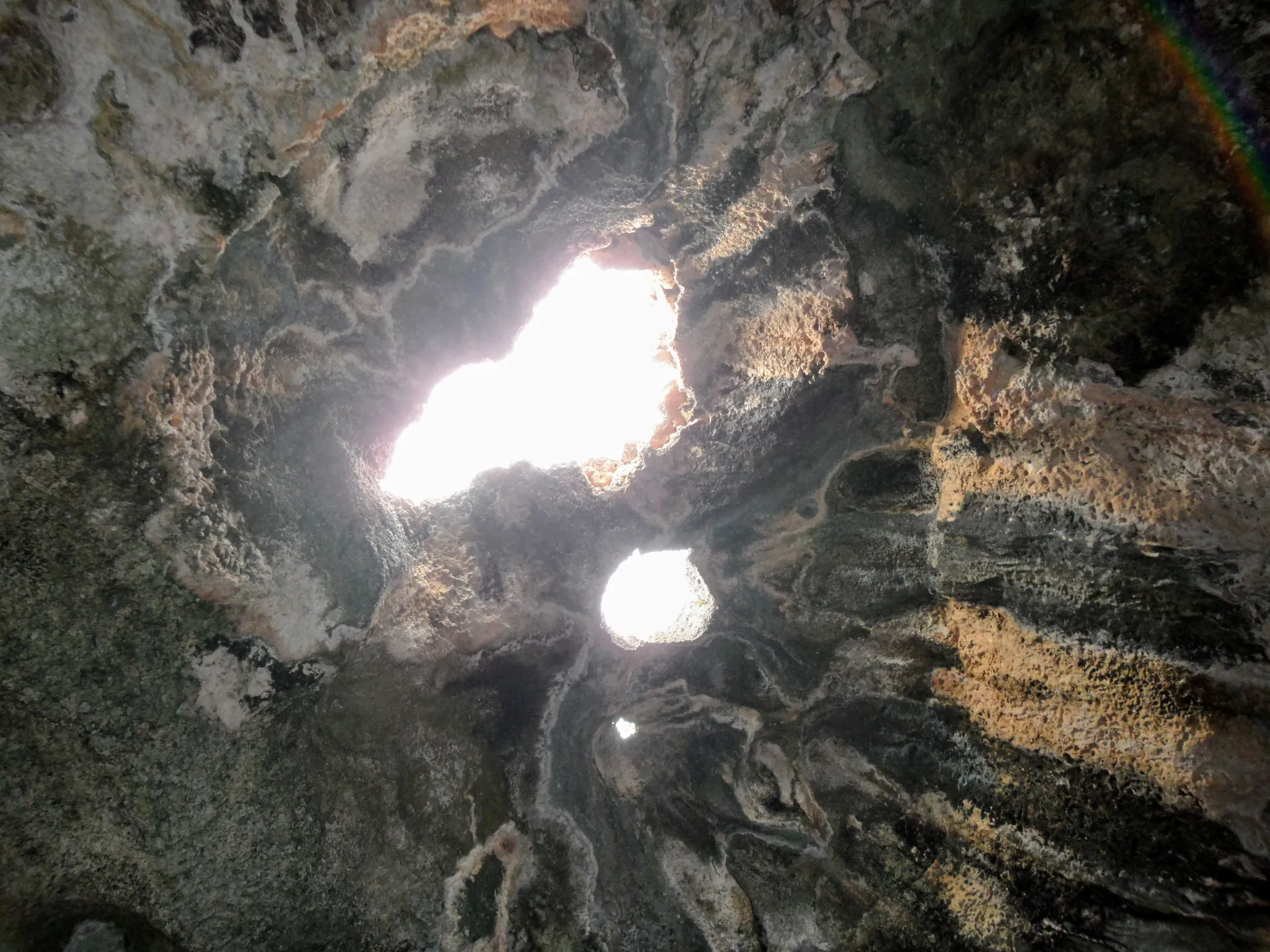
Mid-morning, the beam through the second skylight lands on the floor like a stage light, and everything outside that shaft goes properly dark. That contrast is the whole photograph. Everything else is you standing in the way of it.
- Chamber one: short entry, widest light, best for phone shots and family photos.
- Chamber two: taller, darker, better for wide lenses and long exposures, and where the bats roost.
- The floor is uneven and dusty. Trainers or hiking shoes, not sandals.
- Self-guided throughout, so you set your own pace, which is the single best thing about this cave.
The bats: what you’ll hear, smell, and must not do
Both caves hold bat colonies, and Guadirikiri’s is the bigger one. You’ll smell the guano before you see anything, a warm ammonia note that hangs in the still air of the second chamber. Then you’ll hear the chirping, a dry clicking that rises when someone switches on a phone light. Rangers mention the rare ghost bat among the residents, a tiny insect-eater that biologists keep watch over, and the colony here matters more to the park than any photograph you’ll take of it.
So: no flash, no shouting, no waving torches at the ceiling. Bats wake up when you disturb them, and a woken colony burns energy it needs for the night’s feeding. Walk through the darkness slowly, keep your light pointed at the floor, and let your eyes adjust. The full etiquette rundown sits on our cave etiquette guide, with the hard rules on the visitor rules page. Aruba has no native crocodiles or alligators in these chambers, by the way, and no jungle either. What lives in the caves is bats, spiders, and a few very calm geckos.
Time and effort: stairs versus a flat walk
Guadirikiri asks more of your knees. There’s a stepped approach down to the cave mouth, then a sandy, uneven floor with loose stones, and the walk between the two chambers is longer than photographs suggest. Fontein is a shorter approach from the parking area with more supervision and less scrambling, though you still cross rough ground to reach it and the entry itself is a stoop rather than a stroll.
| Cave | Walk from parking | Stairs | Total time | Wheelchair access | Best light |
|---|---|---|---|---|---|
| Fontein | 2 to 3 minutes, mostly flat | None, low entry | 15 to 20 minutes plus waiting | No | Any time, ranger dependent |
| Guadirikiri | 3 to 5 minutes with steps | Yes, short flight down and back up | 30 to 45 minutes | No | Mid-morning to early afternoon |
Neither cave is wheelchair accessible, and neither has handrails the whole way. If stairs are a problem, Fontein is the kinder visit, and the coastline stops at Boca Prins and Dos Playa are all viewable from the car park. Bring more water than you think you need, wear closed shoes, and remember that the heat inside a limestone chamber at one in the afternoon is nothing compared to the heat on the path outside it. Getting there is covered in detail on our transport guide.
Photography: light beams versus pigment
Fontein, low light and no flash
- Flash is banned on the paintings, full stop. It’s not a soft suggestion.
- Push ISO to 3200 or beyond and brace your elbows against the entry wall.
- Time your frame to the ranger’s torch sweep, not your own shutter instincts.
- Most phones will give you a grainy but usable record. That’s enough.
Guadirikiri, shafts and shadows
- Beams land strongest from mid-morning through early afternoon.
- Expose for the light, let the walls fall dark, and the shot makes itself.
- Tripods are fine if you keep them out of the walking line. Ask first.
- No flash anywhere near the bat colony in chamber two.
Camera settings, angles, and what each chamber does with a phone camera get a fuller treatment on the photos and chambers page, and the seasonal timing question, including cruise-ship mornings and wet-season dirt roads, lives on best time to visit. Short version: the earlier you go, the cooler the walk and the emptier the frame.
Tour combos: how operators pair the two
Almost every guided Arikok trip sold on the island works both caves into a single loop, usually with the Natural Pool, a beach stop, and cold water handed out at the halfway point. The four-hour National Park Arikok Jeep Safari Adventure runs in the morning and covers the caves plus the north coast, while the Natural Pool and Indian Cave jeep safari trades some cave time for reef snorkelling at Conchi. If you’d rather drive yourself, a UTV day like the Aruba UTV north coast route gets you to Guadirikiri’s car park without wrestling with a rental agreement about unpaved roads.
Two things worth knowing before you book. First, park fees are usually bundled into the tour price, so a $99 jeep seat is not as dear as it looks next to car hire plus entry plus fuel. Second, if the Natural Pool is on your wish list, check it’s open the week you travel. Swimming holes in Arikok have been closed at short notice before for rockfall and surf conditions, and no tour operator can guarantee otherwise. Neither cave has a swimming hole, and the cave pool entry that older guides mention is shut, off-limits, and not worth arguing about with a ranger.
Who should choose which
Choose Fontein if you’re
- An archaeology or history person who wants context, not just a photo
- Short on time and stopping for twenty minutes between beaches
- Travelling with a grandparent who can manage a flat approach
- Keen on a ranger telling you something you can’t Google at home
Choose Guadirikiri if you’re
- A photographer chasing a shaft of light with a wide lens
- Happy to spend an hour in a cool, dark space at your own speed
- Travelling with teenagers who’d rather explore than stand in line
- A repeat visitor who’s seen Fontein and wants the bigger room
The people who should skip Guadirikiri are the ones with knee trouble, a fear of tight, dark spaces where the second chamber dips into real blackness, or small children who won’t keep their voices down around roosting bats. Send that group to Fontein and the Boca Prins dunes instead. Anyone with mobility limitations should stay on the paved viewpoints and skip both, because the ground at each entrance is uneven and sandy with no adapted route.
The honest verdict
If you have a car and half a day, do both, in the order that suits your light: Guadirikiri first while the beams are working, then Fontein for the ranger stop on the way to Boca Prins. If something forces a genuine choice, pick by appetite. Rock art and a story told by a person means Fontein. Light, scale, bats, and freedom means Guadirikiri. Both caves sit inside one entrance fee, and Arikok as a whole is worth the drive for the coastline alone, even for travellers who’ve spent a week on Palm Beach and think they’ve seen Aruba.
Take two litres of water each, shoes with grip, and a stub of patience for the tour groups. Danki for reading this far (you’re now better prepared than most people at the gate). Confirm current park hours and entry fees before you set off, and if you’re still packing, our Arikok packing and desert safety guide covers the rest of what your day bag needs.
Official sources and further reading
- Arikok National Park official website for current hours, entry fees, and park notices.
- Aruba Tourism Authority for island-wide trip planning and seasonal events.
- Government of Aruba for national park regulations and protected-area policy.
- Dutch Caribbean Nature Alliance for conservation work across the ABC islands, including bat monitoring.
- Parke Nacional Arikok ranger desk at the San Fuego gate, the fastest source for same-day conditions.